
Where's the Kitchen?
Worldbuild Wednesday ep.34

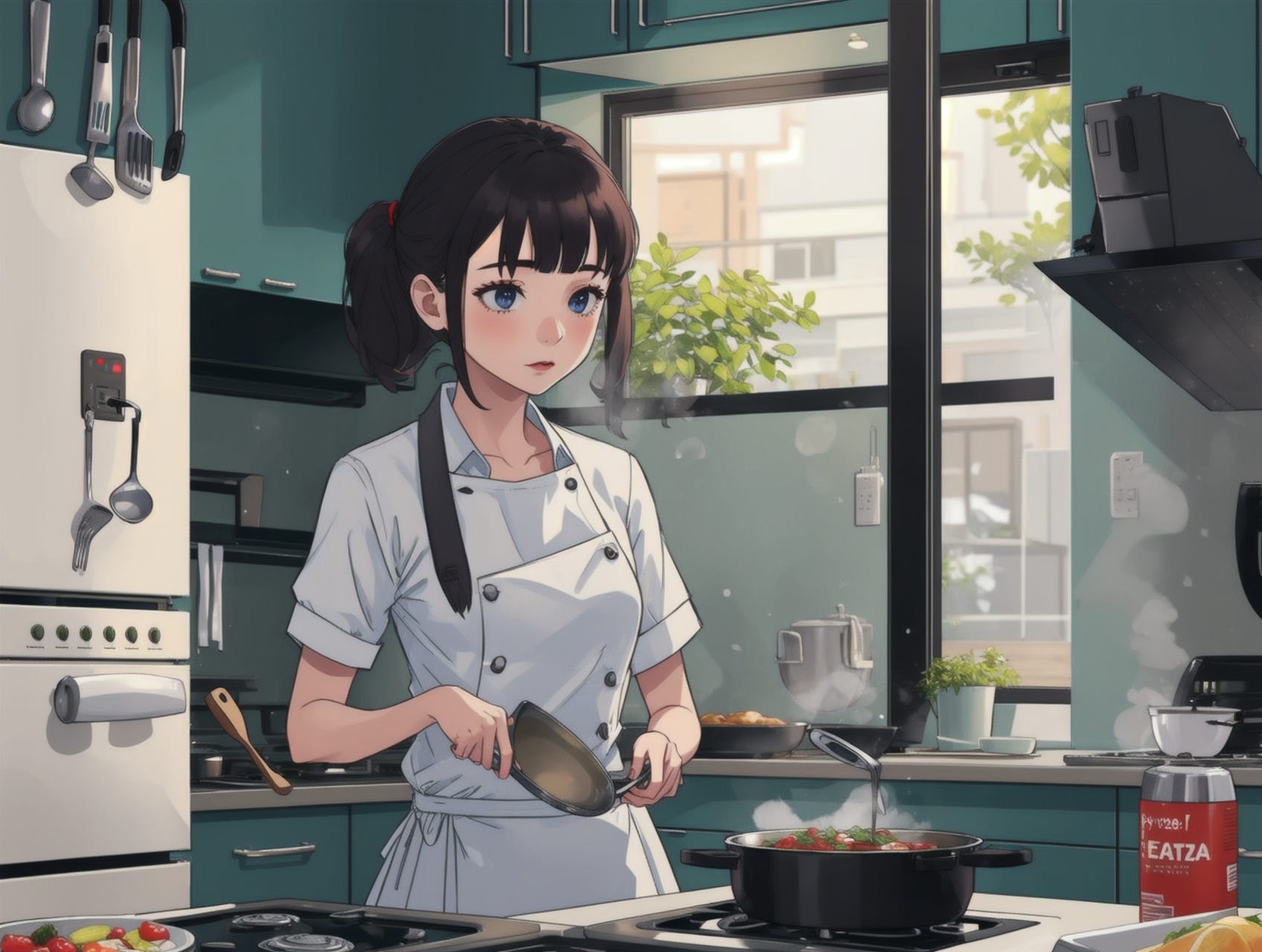
Now we will move on to the second to last topic for November’s food theme: Preparation. Which will be split into two halves, where it is prepared, and how food is prepared. Both play into the culture far more than anything we’ve talked about this month. As where and how a meal is prepared is one of the most obvious and most direct lever over your charters from the world.
Starting with the location, assume we have something similar to ‘yesterday’ most houses, apartments, or other dwellings have a kitchen that will feed the occupants. Contrast that with a world also could be called ‘yesterday’ but every six dwellings share one large kitchen, and it’s always been this way. How different would these two worlds be?
First you have to think about the structures of houses. If the average is one kitchen for every six houses how does that change the city? How does that change the culture? Does it change the family? I will admit this is an extreme example, yet it illiterates a point. What if the kitchen is less separated from the dining area. I know the idea of a breakfast nook, or eating on the kitchen island has gotten more accepted as of late but what if the kitchen was where the meal was to be held. Think of any of the cook at the table restaurants weather its a table grill, hot pot, or something closer to that of Hibachi. Regardless either you cook at your seat or someone cooks next to your seat. Regardless of the specifics how exactly how does this change the way people think about food? I would expect to see a much deeper connection between the culture and the food. Cooking as a skill will be valued or devalued depending on if one is to cook their own food, or cook the food for the family in front of the family. Likewise if one person cooks for everyone in front of them, a degree of showmanship may be valued. Making meals more of an event, again point to Hibachi restaurants as an example.
Yet the inverse could happen, and we go to where the kitchen could be in a separate location from where the meal is to be had by a great margin. I see this like grilling outside and bringing the finished food inside, or any restaurant. That separation of kitchen and meal means there’s a degree of ‘ambiguity’, for lack of a better term, on how the meal was prepared and who prepared it. I see this as the more normal path for worlds to take, as even if the dining room is adjacent to the kitchen it is adjacent to it, no ammount of open plan design will break that separation in people’s minds. If we go to the extreme we could get to the idea outlined at the beginning of this segment where the kitchen is largely separate from the house, and shared between many houses. This may end up having a more community focus brought into cooking. Maybe not the meals themselves as everyone takes their portion back to their house for the meal, yet if everyone cooks with their neighbors that becomes a different culture than one where everyone is cooking in their own homes for their own families. Regardless if the kitchen is so remote that it becomes centralized across families or houses, depending on how one wants to slice it, that will cause a change in the culture, and thus characters.
Which leads into the second half fairly well, who is cooking the meals? If it’s family for family asking who’s duty is it to cook for the family isn’t an unfair question. Is it among the wifely duties or is this something that the first born must take care of once able? The follow on question: how fixable are people with this custom? Is always a fair. Another good follow on question: does it change based on situation? To lay these out into a scenario of just cooks; we will assume family unit will cook for themselves, for now.
Lets say that the wife is expected to cook, and that it’s one of those things that signals a high status wife, and as we are connecting this to culture it signals a higher status in the culture. There is a pair of exceptions, garden parties, and anything to do with the wife’s social life. Meaning should there be a family garden party or if the wife is throwing some kind of party, the husband and or children will be expected to take up the position of cook. The better it is, and the more obvious it is that the wife has nothing to do with the food being produced, again the higher the status. Lets contrast this with another where everyone is to get into the kitchen and work on the meals together. No matter what meal it is everyone should be in the kitchen and helping out. If there isn’t a family member helping that’s seen as defective, or something. Obvious exceptions can be made for the unwell, but if they can be in the kitchen doing something vaguely helpful they are expected to be there. When there’s a party or function and people outside the family are to show up, perhaps each member does a rotation though the kitchen to keep the food going or being worked on and keep the whole family in the function.
Clearly there’s going to be some differences, families may end up much closer knit with the everyone pulls their weight in the kitchen. Which may end up with second and third order effects down the line, that will be left for later Worldbuild Wednesdays. Where as with the Mom first approach there may be a stronger division of labor between men and women, perhaps changing the dating and courtship fronts of the culture, as if women are doing this there must be a culturally equivalent item they should be looking for in a husband. Now put a moody teenager in the mix, one of the “leave me alone mom!” kind, how does that play out? The specifics are hard to find without a more complete world, yet I suspect there should be enough here to start to see the differences.
That said there doesn’t need to be a person making the food, or even a kitchen. What if meals are delivered on demand by robots? You decide what you want to eat and its cooked in a central kitchen by robots, delivered by robot, the robots even set the table and do the dishes for you. If food just appears via robot how does that play into things? I’d suggest there would be a break down of anything downstream of cooking, I’ll save that for next week when we go over meals. If nothing else people who cook may be looked at differently. Is it a luxury to have a kitchen you can use or is it the sign of someone too poor to own robots and a subscription to robo-meals-to-go?
Yet I think things get really interesting when we combine these two, with everything so far. What if we have a very agrarian society with big harvest festivals, perhaps now mechanized so the majority of the harvest is done by the machines yet everyone comes out to do a field or two for the sake of tradition or religion, they then less grocery shop and more schedule groceries to their shared kitchen where their local portion of the clan cook and eat together. How would this play into characters? To jump a few steps forward if there was another culture in the same world where every family had their own kitchen, had to sort their own meals, how would that character interact with this one?
When it comes to using this in story I find this is the most obvious of what we’ve covered so far. Food preparation and how it is handled is often a cornerstone of culture and as such often related to character, and thus plot. Things can resolve though cooking, or come up though cooking, not to mention the option for analogy, idiom, and all the symbolism. When you can tie it in to the world and make all of that deeper, because at the end of the day cooking is a very human act.
With that I’ll cut it a bit short this week, next week will be the final part of this. The meal.
See you then.
I know there’s someone who’s going to ponder “Why didn’t he…” I probably thought about it (comment and I’ll let you know), and decided it belongs with next week, the meal. Yes I did this entire theme to have a meal based Worldbuild Wednesday come out a day before Thanksgiving. Even if last week was a bit of a stretch.
For those who are visiting Sci-Fi Saturday is going up this weekend subscribe to get it in your email. I’m talking star ship classifications. Will probably ruffle some feathers, and probably spark at least one new sci-fi novel. I don’t think you’ll want to miss it.
Lastly I’m going to keep leaving this ‘letter to the editor’ button to see who pushes it.
"Where's the kitchen? Where I keep my wife."
Anyway. Once again, I have the luxury of drawing upon existing traditions. My Rus characters would see the kitchen, with a small table, as the center of the household; if friendly, they immediately draw you in and pour vodka ("Any meeting which does not begin with a drink is assumed hostile" is axiomatic in my works). The Japs would have a much smaller kitchen with somethiing like a narrow counter separating it from the dining table. Imperials, being former Americans, would have what we would look around and see about our homes today. There are some outliers for the wealthy as I mention three large houses where the kitchen, dining area, and living room/hearth are one open floorplan.
On Mars, with space at a premium, they tend much more the Jap style. A place for everything and everything in its place.