
Threading Stones
An Interview with Maeve Brooks

Hello all, another interview. Big thanks to Mr. Joe Isenberg for putting me in contact with the lovely Maeve Brooks, who has her first book Thread and Stone that out not too long ago.
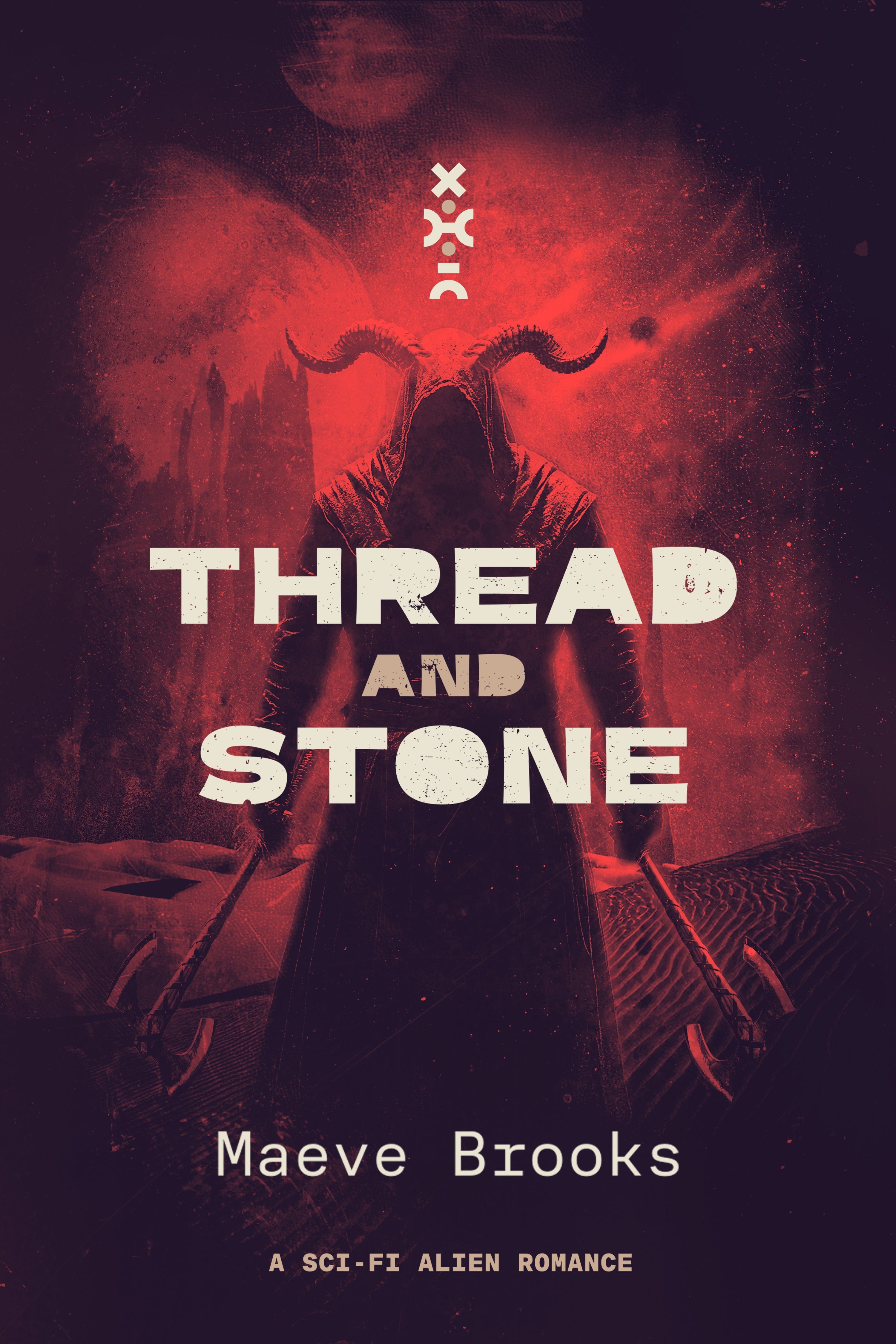
Q: Did Thread and Stone start as a worldbuilding project or a story? Which drove writing more in the early stages?
A: The book started as a pretty basic love story between an alien guy and a human woman. I honestly wasn’t expecting to create an expansive world or a complex plot, but somehow, every time I encountered another plot hole and fixed it, the world expanded and the plot grew.
Essentially, every step I made in the writing process revealed another problem that had to be solved with backstory and world-building. The book went from being rather simple—an alien saving a human woman from enslavement—to being a complex story about a human woman saving an alien king from a lifetime of propaganda, and the alien king saving her from a lifetime of imprisonment. (Definitely a better love story, I think.)
And the biggest thing that drove the worldbuilding was Vexar’s character arc (Vexar is the main male character). I needed him to be naive enough to believe in the honor and decency of his empire, but intelligent enough to accept his new reality and pivot quickly. His character is what drove me to create the complex political and social backdrop of the story.
Q: What is one piece of the world you think readers will overlook and one that you hope they can’t miss?
A: Vexar’s culture, the Vhorathi culture, values their history to an almost pathological extent. They’re focused on living like their ancestors, being honorable, and keeping tradition alive. And, as the story progresses, there are hints that this adherence to a bygone way of life is more a tool for control than anything else.
In the book, we see Vexar struggle to reconcile a lifetime of propaganda with his current reality, and while that struggle is seen through a very personal lens, it reflects these deeply ingrained cultural beliefs that affect every choice he makes. The power Vexar’s culture holds over him is a huge aspect of the story, but it’s never outright stated that way. I’m certain the more personal aspects of Vexar’s struggle outshine the cultural undertones, and for that reason, I’m sure it will get missed. But it’s there. And it’s a huge driver of his character.
The detail I’m hoping readers don’t miss is the strange mix of ancient culture and modern tech. In the story, you learn that the Vhorathi people are capable of traversing star systems, but they still function under a monarchical empire. They travel using wormholes, but require their rulers to ‘prove’ themselves in a battle to the death.
All of this was born out of the idea of a space-faring culture that didn’t create its own technology, but instead, stole it from a more advanced species. They jumped the technological line, so to speak, and it resulted in colonialism on a massive and terrible scale. Imagine if we gave the rulers of humanity access to weapons that could destroy planets, traverse solar systems, and conquer worlds. Would they keep it under lock and key, or would they immediately try to ‘neutralize’ any sentient species near us as a way of ‘protecting our future’? While I’m not sure if anyone will pick up on the larger context of this, at least not in this first book, I’m sure they will find it strange that this empire is functioning the way it does.
Q: It sounds like there’s a precursor species, or something similar. Were they in the plan from the start or were they a plot hole you had to fill in?
A: There is a precursor species, the Tusku, and they were not part of my original plan. When I was trying to figure out how Amara got to the Coliseum (where this book is set), I needed a species that could be responsible for her abduction. The species needed to be capable of abducting individuals from multiple planets without drawing suspicion; they needed to be immune to the influence of other species; and they needed to have little to no empathy. Thus, the Tusku was born.
They are a hyper-advanced species who’ve been engineering stars for longer than humans have had language, and they play a large role in the next two books. In this first book, they’re just mentioned as the species that runs the black market and the species that failed to conquer the Vhorathis. Although it’s still not clear why the Tusku are participating in any of this. That will be explored later in the series.
Q: Back on the subject of culture, it seems these guys fall well into the Dark Forest theory of the galaxy: ie if you find evidence of another intelligent species you need to wipe them out before they wipe you out. Did that have anything to do with either the aforementioned precursors or your thoughts creating this culture?
A: That’s a great question, and yes, the Dark Forest theory did influence my creation of the Vhorathi culture and how they handled expansion. Before they encountered the Tusku (and stole a few of their ships), the Vhorathi’s had a ‘global’ economy, but were organized in smaller, tribal communities and relied on warfare to handle most of their disputes. Their culture primed them to view outsiders as a threat, and it makes sense that their view of the galaxy would be similar—kill or be killed, conquer or be conquered.
Q: Both of these answers imply a lot of alien species. How did you solve the multi-species society question? As you have an empire, did you take one of the empires of Earth and transpose it into the stars, using their solution to the multi-ethnic state, or did you play into the aliens being alien and work to invent something that is different to the empires seen on Earth?
A: I didn’t base the design of the Vhorathi Empire on any single human empire, but there are plenty of parallels that could be drawn. I would loosely describe the structure as an Authoritarian Federation, where each species has basic control over its planet, but is required to meet specific trade and financial obligations to the empire. There is a Senate, with representatives from each species, but those representatives are not elected in any meaningful way. It’s more like a club for the rich and powerful to hoard control and trade the well-being of their people for whatever trivial thing they want.
The empire gained its power (and maintains it) by making participation the price each species pays for protection from the Tusku. Using a combination of carefully curated propaganda, financial pressures, bribes, treaties, and the Vhorathi’s technological superiority, each species has come to believe that participation is not a choice but a necessary sacrifice to protect themselves from an existential threat.
Having each species function independently helps solve a large part of the multi-species society question. Biological differences aren’t much of an issue when there is limited interaction between species. The rest of the ‘society’ question is solved by having everyone focused on a single threat—the Tusku.
When we see multiple species working together in the Coliseum, they were all selected because they were biologically compatible with the planet and the work. (I guess it helps to have such a large number of species to choose from in situations like that.)
Q: It seems that the Coliseum is one of the few places where multiple species interact with each other in daily life, making it an exception to the rules that you’ve outlined above. How much does this exceptional nature play into the story and the story play with the exceptional nature of the location?
A: You’re absolutely right, the Coliseum is the focal point of the empire’s inter-species relations, and the collision of politics, violence, and power that occurs there is the foundation of the story.
Originally, the Coliseum was built for the rulers of the Vhorathi Empire to prove their worth in a rite of passage called “The Obligation”. Before assuming the throne, any future leader of the empire must battle in the arena. If they survive, they’re deemed ‘worthy’. This has been a long-standing tradition in Vhorathi culture, and they’ve devoted an entire planet to it—to showing the Empire the strength and ferocity of their next ruler.
In the time the story is set, the Coliseum’s purpose has expanded from a ceremonial location to a hub of gladiatorial fighting, gambling, back-room politics, and black-market dealings under the leadership of the story’s villain, The Magistrate.
Amara, our main female character, is one of many people (of many species) enslaved and forced to work at the Coliseum. Without giving too much away, she’s the only human in the story, and she’s being forced to work as a nurse, caring for injured gladiators.
Vexar is at the Coliseum to complete his “Obligation”. His mother, who was the Queen of the empire, has died, and now Vexar must fight to claim his throne. However, due to the very nature of the Coliseum and its relationship to power, politics, and greed, it’s a dangerous place for a future leader, and during his fight, Vexar is gravely injured.
Lucky for Vexar, our ex-combat medic Amara is willing to risk her life to save him, and her selfless act is what throws the entire story into motion
Q: Is the Coliseum a whole planet or a location on the planet? On one had the idea of leadership via battle royale where all the candidates are dropped on a planet, in roughly the same area. Or is it functionally a single elimination tournament?
A: The Coliseum and the surrounding settlement are the only structures on a terraformed planet called Calidus. The narrow, singular use of the planet is meant to be overly extravagant, and the planet’s remote location ensures that only the wealthiest of society can attend the fights that occur there.
The process of using the Coliseum to select a ruler is more of a ritual than an actual method of selection. The current ruler selects a member of their immediate family to be their primary successor, and they select a few backup options in case their first choice fails. When a ruler dies, their chosen successor goes to the Coliseum, signs away their freedom as a gesture of trust/confidence, and completes three fights to earn their freedom and their throne. If they survive, they become the next ruler. If they die, whoever’s next in line completes the same process.
The process is rooted in the Vhorathis tribal history, where warfare was common, and the next leader of a tribe would have naturally been a fully blooded warrior. After the Vhorathis beat the Tusku back and united under one leader, they realized their new leaders were no longer warriors. So, to keep their identity alive, they created the Coliseum and the Obligation.
Q: Who runs the show when the new ruler is in the Coliseum? Seems like there could be a gap between the Old and New Reigns which, historically hasn’t ended well for nations.
A: The Senate, which handles most of the day-to-day affairs for the Empire, handles everything while the successor is completing their rite of passage in the Coliseum. But you’re right, there is a clear gap in leadership that is filled with little more than trust that those involved in the process will be honorable, and as we all know, honor only goes so far.
Inside the Coliseum, the Magistrate handles everything regarding the successor’s fights, but there is some level of oversight. If the successor is killed, an investigation would be completed by an uninvolved third party to verify that nothing nefarious occurred. However, that investigation would not occur if the successor was found to have violated one of the rules or been involved in something … untoward.
That’s all I can say about that without giving too much away. If you want to know more about the loopholes and risks in the succession process, you’ll just have to read the book.
Q: Of course we will. Is there anything else you’d like to say?
A: I just wanted to thank you for inviting me to share a bit of this world with you and your readers. It’s been a blast getting to talk about all of it.
For anyone interested in reading Thread and Stone, the ebook is available for free on Kindle Unlimited or for purchase on Amazon, and the paperback is available wherever you buy books.
My linktree: https://linktr.ee/MaeveBrooks
By Thread and Stone: Ebook or Paperback on Amazon (Also free to read on KU)
Paperback available wherever books are sold!
Big thanks to Maeve Brooks to fitting in an interview during the holidays. If you’re interested in Thread and Stone check it out. Maeve is a wonderful author and I am looking forward to seeing what is next.
Learning curve. It's one of the problems I had with Mark and Preston's books: the amount of backstory you need to come up to speed to understand what the hell is going on. I'm lazy and base my stories around a near-future history. One of your stories was similar; the one with foot/endnotes was a bit more complicated. Even set 6000 years from now, Joe's is remarkably folksy in its telling.
Saying all that to say this: it was a slog to get people one, two, three generations ago to "come up to speed." In this day of pocket Molochs, I think an author has a much more difficult time of it.
Great job as always, Grathew!