
How Matches are Made
Worldbuild Wednesday ep. 42

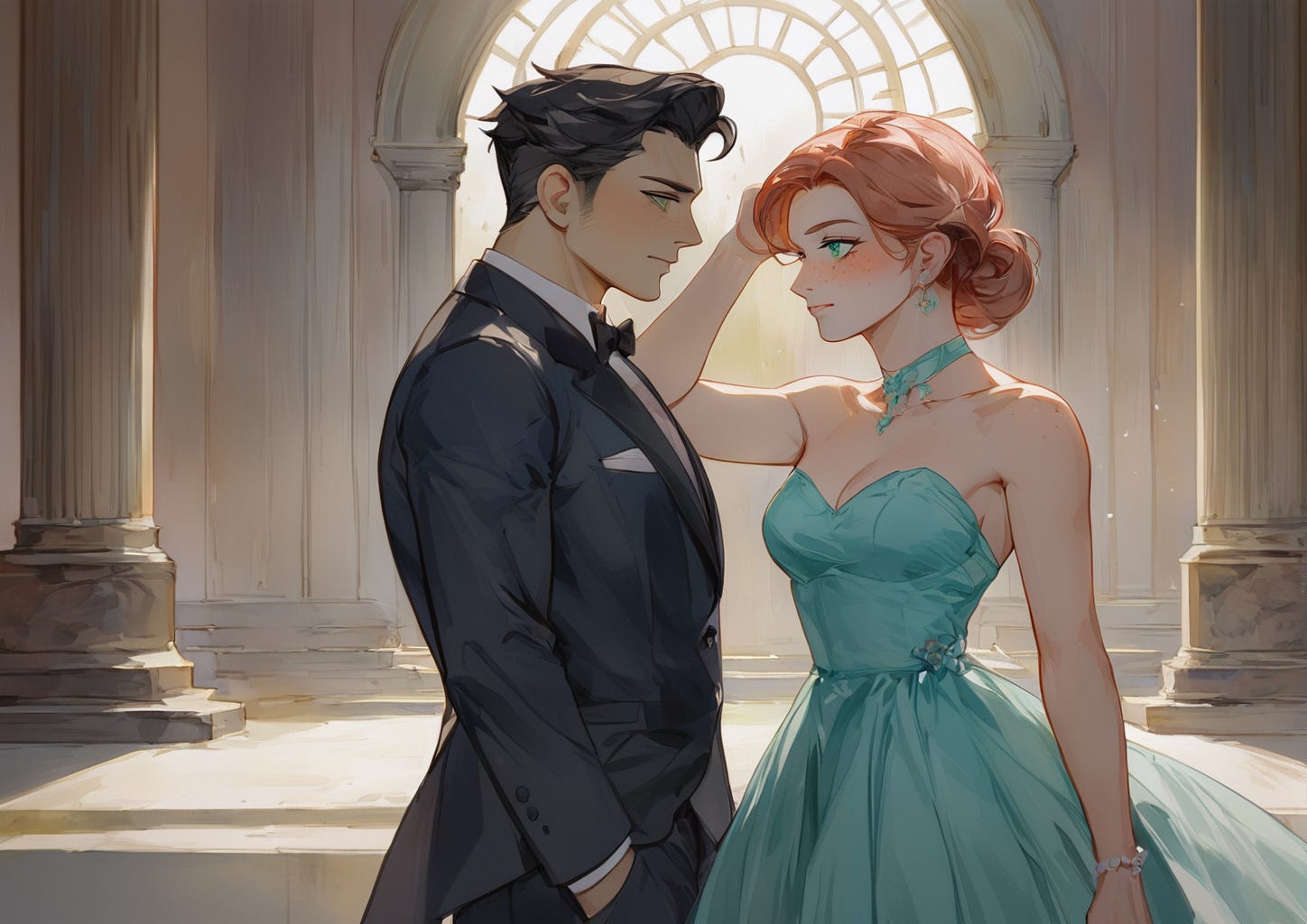
Romance is only romance because of the rituals. The awkward dances, the signs, signals and untimely the ceremonies that bind for life. With out the rituals one would see the contracts and negotiations laid bare.
Romance is more than just a system of rules. It is also a system of rituals, a system of ceremonies. These rituals are never simply old traditions, as they form their own complex webs of situations and stories spanning across both culture and history. These rituals and ceremonies are what we are going to be touching on today. These complex items are features, and distillations of cultures and thus grow over decades upon centuries, giving meaning to every item, color, and movement. These rituals form the system that formalizes the matches and makes them into something that can be celebrated, remembered and honored. For rituals and ceremonies are what elevate a romance from a contract to produce children into the institution that continues to develop culture and traditions.
Starting out we have to define what is a ritual, and what is a ceremony. An in depth exploration of both will be for later in this year, thus working definition is required. A ritual is a set of actions taken for a specific meaning that is repeated without changing the meaning. A ceremony is a set of actions taken for a specific meaning that only happens once. To the character traveling though the romance may not realize that the two are different until they have already happened. Which is more important will come down to the cultures involved. With some cultures putting more emphasis on the rituals of the romance as a way to find and remove impurities in the relationship, others may focus the ceremonies as they celebrate and announce the transition though the stages of the romance. Make sure that if a culture picks one over the other it is consistent throughout the culture.
Knowing what rituals are expected by the cultures and the players during the romance is important. It could be something as simple as the man holding the door for his woman, or as complex as a formal ball. Generally rituals should be things that are repeatable often, and hold meaning for both sides of the relationship. If a ritual becomes one sided it tends to vanish. Meaning rituals that last a long time are meaningful for both parties and repeatable enough to make it into the cultural standard. Generally speaking the bigger the ritual the less frequent it should be, however that is untimely a cultural decision. This means things like anniversaries, romantic holidays, and other events on the yearly scale often carry more weight than the things one can do daily or weekly. There are also personal or couple created rituals where the two players create a ritual themselves that they participate in.
It is important to note that not all cultures will accept couples making their own rituals. Some may end up policing the two for the rituals they create. These rituals and the societal actions around said rituals often make for juicy stories and good plot points for the romance storytellers out there. Therefore take note of it, and figure out what he rules are around creating rituals, and participating in the standard ones.
Thus rituals are often much more at the worldbuilder’s discretion when it comes to how they are created. Rituals also cover a lot more ground within the relationship than ceremonies, due to the more common nature of the ritual. There are also two camps of rituals, challenges and displays. Challenge rituals are when one party or the other starts, or uses, the ritual to test the other party. Generally this can be framed as a question: “Does he pay for the date?” being a good example. The answer: yes, no, I didn’t let him influences and decides the outcome of the challenge. Displays are generally the opposite of a challenge. This is when one party goes to the other and says: “Look at this!” with this being a connection or resource that the player has. Displays can also be a way of signaling to each other, and the community, we are at this phase of our relationship.
Ceremonies on the other hand are often very formalized. These can be fore the couple’s sake although they often serve the community as much as the couple in question. Thinking about these as festivals the couple must either participate in, or host is a good grounds for creating them. In the world of romance the ceremonies are the large pieces that push for community involvement and policing. Ceremonies are often where the couple will be judged and possibly wedged apart if the community doesn’t agree with the pairing. This may seem simple, yet it is something I often see under used in both stories and the worlds backing them. The best example comes form the line: “speak now or forever hold your piece” highlights this. The wedding is forever, the ceremony hasn’t completed yet, and everything that has happened so far can be undone. That line is not for the couple, it is for the community to say “I object” and make their case for stopping the union. Most, if not all, ceremonies either draw attention to the couple to get approval, or raise issues with the pairing.
Because of this community involvement the worldbuilder should go though the steps outlined last month’s theme of festivals and celebrations. This formalization of the event means there is often less space for deviation within the ceremony than there is with the ritual. Likewise it would be hard, to impossible for a couple to create their own ceremony without there being some kind of uproar from the community. Thus the treatment of the ceremony needs to be handled with a degree of weight and dignity that rituals don’t require. Likewise each step of the ceremony should have the weight of the history and traditions that created it, and affect the couple accordingly.
It is important to realize that the two aren’t as separate as one may think. Often larger rituals connect into or hold ceremonies for couples. Ceremonies often contain rituals. Thus a degree of entanglement is required to get the proper effect when it comes to telling the story of a romance. Yes if one wants a ceremony can be a formalized version of a ritual, and a ritual can be an informal ceremony. It can be tricky to land, yet when done right it adds to the layers of the world and builds the verisimilitude.
To create a ritual, I will pull in our friend from last month: The Autumn Ball. This is a ritual with a ceremony within it. The ritual is the formal ball, supported by the etiquette intra and inter couple interactions. This would be one of the largest rituals one could create, and one that has the community interactions of a ceremony. Thus I would break it down into a number of smaller rituals. The entire thing is meant to be a display, yet it is also a challenge. Has their relationship advanced far enough to get him to invite her to this large event where everyone will be scrutinizing the couple? As everything the couple does will fall into the public eye.
The rituals within the Autumn Ball present many opportunities for couple to show off, and test each other. Equally important is the fact the ball as a hole is a ritual and one where the community will flex it’s power as the board and the moderating power. Thus the community would work to use the rituals within the Autumn Ball as a challenge wedges. Either the couples make it though and become stronger or the ball breaks them apart. Meanwhile each of the couples would then be pushed use the ball to show off to each other, and the community. Putting it into story terms: the board is putting down a gauntlet, if you attend you’re picking it up and will have to deal with the pressures of it. By picking up the gauntlet the couple has a chance to show off to everyone around them. Thus offering a risk and reward for those in attendance.
It is important to note that the challenge and opportunity afforded to couples by the Autumn Ball is what feeds into its weight as a festival. This is a symbiotic relationship with these kinds of event based rituals. The more it weights the more powerful the ritual, which justifies the weight. Meaning this may be one of two or three major events in the ‘romantic calendar’ at this college. Making sure that any and all actions done by a couple interacting with it will cause something to happen: someone will notice and someone will talk to say the least.
Meaning my notes for the Autumn Ball as a ritual will focus on what it generally means to the couples that participate in it. I would pair this often with the romance rules that would be enforced or enforceable during this ritual as it is one that functionally takes a full weekend. Thus my notebook would have something like the following:
The Autumn Ball is a formal ball where everyone has eyes on everyone. Couples are here to show off the status of their relationship as much as they are to enjoy an evening together. As such each year has a color palate to signal the relationship status, a theme to coordinate around, dances to participate in and generally a degree of couple’s mingling where couples interact with each other as couples. Rather than individuals as may be the case outside of the ball.
The main rules are:
The woman must match the color assigned to her, and ensure her man matches the color.
The couple needs to stay together throughout the night.
The couple needs to present as a couple, not two individuals together at a party.
This is by no means the exhaustive list of what I would put together for such an event, yet it is the core of what would make the Autumn Ball the Autumn Ball. The other half of this equation is how characters interact with the rituals and ceremonies. Again I will call back to the festivals, as there is some overlap with the character interactions of both. From the worldbuilding angle the culture will inform what people see as the correct way to interact with these rituals and ceremonies. If characters accept or reject these cultural teachings, their thoughts and actions will give us insight into the culture as well as how they are treated for embracing or rejecting the norms.
Accepting or rejecting these rituals and ceremonies is the final set of levers granted to the story teller. The rituals and ceremonies do provide leavers that can make or break a romance, yet it is how characters interact with hem that really ends up adding a lot of depth to the system. Meaning one cannot ignore how the characters themselves think and interact with what's going on in the rituals and ceremonies.
While there is a lot more to rituals and ceremonies in general we are coming to the end of how they interact with romance. Don't worry I will delve into rituals and ceremonies more in a future month. Regardless the rituals of romance are what are done repeatedly to build up the romance, day in day out. Ceremonies are not simply larger rituals but rather milestones along the way, and places where the referees will watch, and intervene if they feel intervention is required. Often testing and assessing the couple along the way. Meaning the rituals will be what makes the romance spark with excitement and the ceremonies will be what bind it for life.
Love to comment. Can i?